Carbon Markets
Understanding Carbon Credits
06 Dec 2023
Carbon Markets 101
A carbon market allows investors and corporations to trade both carbon credits and carbon offsets simultaneously. This mitigates the environmental crisis, while also creating new market opportunities. New challenges nearly always produce new markets, and the ongoing climate crisis and rising global emissions are no exception.
The renewed interest in carbon markets is relatively new. International carbon trading markets have been around since the 1997 Kyoto Protocols, but the emergence of new regional markets have prompted a surge of investment.
The advent of new mandatory emissions trading programs and growing consumer pressure have driven companies to turn to the voluntary market for carbon offsets. Changing public attitudes on climate change and carbon emissions have added a public policy incentive. Despite an ever-shifting background of state, federal, and international regulations, there's more need than ever for companies and investors to understand carbon credits.
Carbon Credits, Offsets and Markets - An Introduction
The Kyoto Protocol of 1997 and the Paris Agreement of 2015 were international accords that laid out international CO2 emissions goals. With the latter ratified by all but six countries, they have given rise to national emissions targets and the regulations to back them. With these new regulations in force, the pressure on businesses to find ways to reduce their carbon footprint is growing. Most of today's interim solutions involve the use of the carbon markets.
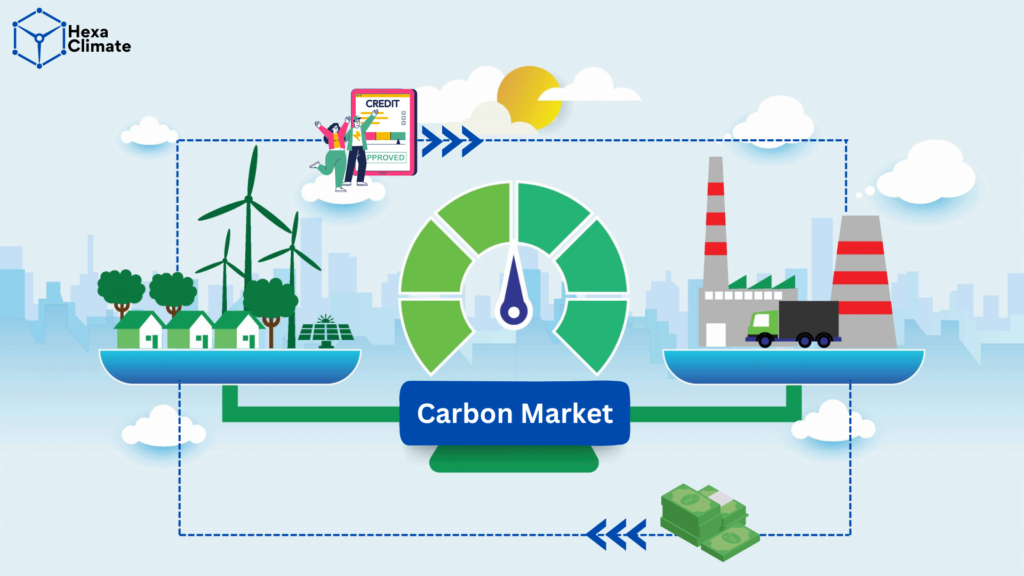
What the carbon markets do is turn CO2 emissions into a commodity by giving it a price. These emissions fall into one of two categories: Carbon credits or carbon offsets, and they can both be bought and sold on a carbon market. It's a simple idea that provides a market-based solution to a thorny problem.
What are carbon credits and carbon offsets?
The terms are frequently used interchangeably, but carbon credits and carbon offsets operate on different mechanisms. Carbon credits, also known as carbon allowances, work like permission slips for emissions. When a company buys a carbon credit, usually from the government, they gain permission to generate one ton of CO2 emissions. With carbon credits, carbon revenue flows vertically from companies to regulators, though companies who end up with excess credits can sell them to other companies.
Offsets flow horizontally, trading carbon revenue between companies. When one company removes a unit of carbon from the atmosphere as part of their normal business activity, they can generate a carbon offset. Other companies can then purchase that carbon offset to reduce their own carbon footprint.
How are carbon credits and offsets created?
Credits and offsets form two slightly different markets, although the basic unit traded is the same - the equivalent of one ton of carbon emissions, also known as CO2. It's worth noting that a ton of CO2 does refer to a literal measurement of weight.
Carbon credits are issued by national or international governmental organizations. Credits are frequently issued under what's known as a "cap-and-trade" program. Regulators set a limit on carbon emissions - the cap. That cap slowly decreases over time, making it harder and harder for businesses to stay within that cap.
Organizations with operations that reduce the amount of carbon already in the atmosphere, say by planting more trees or investing in renewable energy, have the ability to issue carbon offsets. The purchase of these offsets is voluntary, which is why carbon offsets form what's known as the "Voluntary Carbon Market".
What is the carbon marketplace?
When it comes to the sale of carbon credits within the carbon marketplace, there are two significant, separate markets to choose from. One is a regulated market, set by "cap-and-trade" regulations at the regional and state levels. The other is a voluntary market where businesses and individuals buy credits (of their own accord) to offset their carbon emissions.
Case Study Example
Let's say two companies, Company 1 and Company 2, are only allowed to emit 300 tons of carbon. However, Company 1 is on track to emit 400 tons, while Company 2 will only be emitting 200 tons. To avoid a penalty, Company 1 can make up for emitting 100 extra tons of CO2 by purchasing credits from Company 2.
The Difference between the Voluntary and Compliance Markets
The voluntary market works a bit differently. Companies in this marketplace have the opportunity to work with businesses and individuals who are environmentally conscious and are choosing to offset their carbon emissions because they want to. There is nothing mandated here. For example: in 2021, the oil giant Shell announced the company aims to offset 120 million tonnes of emissions by 2030.
How to produce carbon credits
Many different types of businesses can create and sell carbon credits by reducing, capturing, and storing emissions through different processes:
Renewable energy projects,
Improving energy efficiency,
Carbon and methane capture and sequestration
Land use and reforestation.
- Renewable energy projects have already existed long before carbon credit markets came into vogue. Many countries in the world are blessed with a natural wealth of renewable energy resources. Countries such as Brazil or Canada that have many lakes and rivers, or nations like Denmark and Germany with lots of windy regions. For countries like these, renewable energy was already an attractive and low-cost source of power generation, and they now provide the added benefit of carbon offset creation.
- Energy efficiency improvements complement renewable energy projects by reducing the energy demands of current buildings and infrastructure. Even simple everyday changes like swapping your household lights from incandescent bulbs to LED ones can benefit the environment by reducing power consumption. On a larger scale, this can involve things like renovating buildings or optimizing industrial processes to make them more efficient, or distributing more efficient appliances to the needy.
- Carbon and methane capture involves implementing practices that remove CO2 and methane (which is over 20 times more harmful to the environment than CO2) from the atmosphere. Methane is simpler to deal with, as it can simply be burned off to create CO2. While this sounds counterproductive at first, since methane is over 20 times more harmful to the atmosphere than CO2, converting one molecule of methane to one molecule of CO2 through combustion still reduces net emissions by more than 95%. For carbon, capture often happens directly at the source, such as from chemical plants or power plants. While the injection of this captured carbon underground has been used for various purposes like enhanced oil recovery for decades already, the idea of storing this carbon long-term, treating it much like nuclear waste, is a newer concept.
Land use and reforestation projects use Mother Nature’s carbon sinks, the trees and soil, to absorb carbon from the atmosphere. This includes protecting and restoring old forests, creating new forests, and soil management.
Plants convert CO2 from the atmosphere into organic matter through photosynthesis, which eventually ends up in the ground as dead plant matter. Once absorbed, the CO2 enriched soil helps restore the soil’s natural qualities – enhancing crop production while reducing pollution.
How companies can offset carbon emissions
There are countless ways for companies to offset carbon emissions.
Though not a comprehensive list, here are some popular practices that typically qualify as offset projects:
- Investing in renewable energy by funding wind, hydro, geothermal, and solar power generation projects, or switching to such power sources wherever possible.
- Improving energy efficiency across the world, for instance by providing more efficient cookstoves to those living in rural or more impoverished regions.
- Capturing carbon from the atmosphere and using it to create biofuel, which makes it a carbon-neutral fuel source.
- Returning biomass to the soil as mulch after harvest instead of removing or burning. This practice reduces evaporation from the soil surface, which helps to preserve water. The biomass also helps feed soil microbes and earthworms, allowing nutrients to cycle and strengthen soil structure.
- Promoting forest regrowth through tree-planting and reforestation projects.
- Switching to alternate fuel types, such as lower-carbon biofuels like corn and biomass-derived ethanol and biodiesel.
Voluntary vs Compulsory: The biggest difference between credits and offsets
Participation in a cap-and-trade scheme typically isn't voluntary. Your company either needs to abide by carbon credit limits set by regulators, or no such limits exist. Carbon credits intentionally add an extra onus to businesses. In return, the best cap-and-trade programs provide a clear framework for reducing carbon emissions.
Participation in a cap-and-trade scheme typically isn’t voluntary. Your company either needs to abide by carbon credit limits set by regulators, or no such limits exist. As more and more countries adopt cap-and-trade programs, companies increasingly need to participate in carbon credit programs.
Carbon credits intentionally add an extra onus to businesses. In return, the best cap-and-trade programs provide a clear framework for reducing carbon emissions. Not all programs are created equal, of course, but at their best, carbon credits have a clear impact on total carbon emissions.
The Two Types of Global Carbon Markets: Voluntary and Compliance
There’s one more important distinction between carbon credits and carbon offsets:
Carbon credits are generally transacted in the carbon compliance market.
Carbon offsets are generally transacted in the voluntary carbon market.
References
www.carboncredits.com
www.hexaclimate.com – Your Net-Zero Partner!